Documents
 United States
 Shield AI
V-BAT
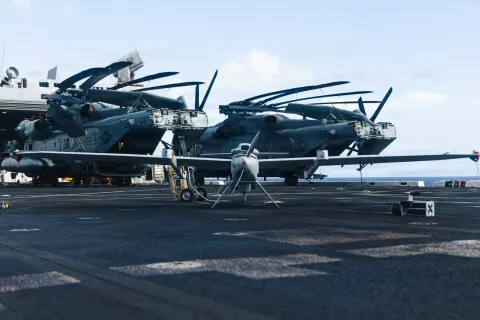
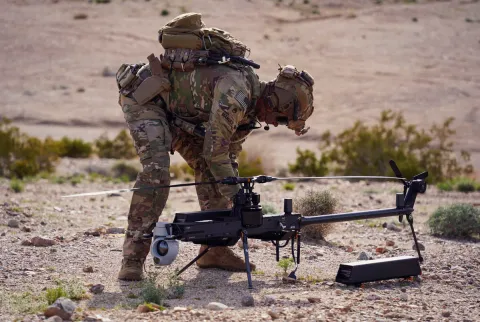
A Group 3 vertical-takeoff-and-landing ISR drone with a ducted-fan tail-sitter design, built by Shield AI (via its 2021 acquisition of Martin UAV) for shipboard, rooftop and austere-site launch and recovery without a runway or catapult. In service with the U.S. Navy, Army, Marine Corps and Coast Guard, with export orders from Japan, the Netherlands, Romania, Ukraine, Brazil, Greece and Indonesia.
In service since 2021
Compiled from public sources ·primary reference ↗
90
km/h
5,500
m ceiling
Procurement snapshot
Availability & export
US ITAR-controlled
Export needs U.S. State Dept (DDTC) approval; end-use & re-transfer restrictions apply.
Channel: Foreign Military Sales (FMS) or Direct Commercial Sale
Fielded & proven
Operator data not public
In service since 2021. Status: active.
Lifecycle cost (est.)
No public unit price to model from. Why so few systems publish one →
Interoperability
No standardised NATO calibre / datalink detected in public specs.
Competitive field
70 comparable systems from 35 other manufacturers
Counted in the WeaponSpecs database: UAVs built by another manufacturer that share at least one published role with this system. A count of what this catalog holds, not a survey of the whole market. See the alternatives →
Derived guidance from public data, export regime by country of origin, lifecycle from the GAO ~30% acquisition rule. Verify eligibility, pricing and offsets with the manufacturer and your acquisition authority.
Full specifications
Performance
Speed, range, altitude and engagement capability.
| Max speed Maximum level speed. For aircraft this is at optimal altitude; for ground vehicles, top road speed. Higher means faster response and better kinematic performance. | 90 km/h |
|---|---|
| Service ceiling Maximum operating altitude. Higher gives energy advantage and sensor horizon. | 5,500 m |
| Endurance Time on station. Critical for UAVs and patrol platforms, higher means longer persistent coverage. On a ground robot, published continuous run time on a full charge or fuel tank. | 13 h |
Physical
Dimensions, weight and crew.
| Length Overall length including gun/probe where applicable. | 3.81 m |
|---|---|
| Wingspan Wingtip-to-wingtip span. | 2.93 m |
| Combat weight Fully loaded weight. Lighter eases transport and bridging limits; heavier often means more armor. | 73 kg |
Propulsion
Engine, power and fuel.
| Propulsion type Turbofan, turboshaft, diesel, gas turbine, solid-fuel rocket, ramjet… | Heavy-fuel engine (JP-5), ducted-fan VTOL |
|---|
Sensors & avionics
Radar, sensor suite and datalinks.
| Sensors IRST, EO/IR turrets, laser designators, sniper pods, thermal sights. | Electro-optical (EO) camera, Mid-wave infrared (MWIR) camera |
|---|
Specifications compiled from public Shield AI and reference sources ↗. Published defense figures are approximations, treat comparisons as directional. Last verified 2026-08-03.
Compare with rivals
See how it stacks up
 Turkish Aerospace Industries ANKA-S
 Frequently asked questions
What is the top speed of the Shield AI V-BAT? +
The Shield AI V-BAT has a maximum speed of 90 km/h.
How much does the Shield AI V-BAT weigh? +
The Shield AI V-BAT has a combat weight of 73 kg.
What is the Shield AI V-BAT used for? +
The Shield AI V-BAT is a uav / drone typically used for isr.